Corn Silage
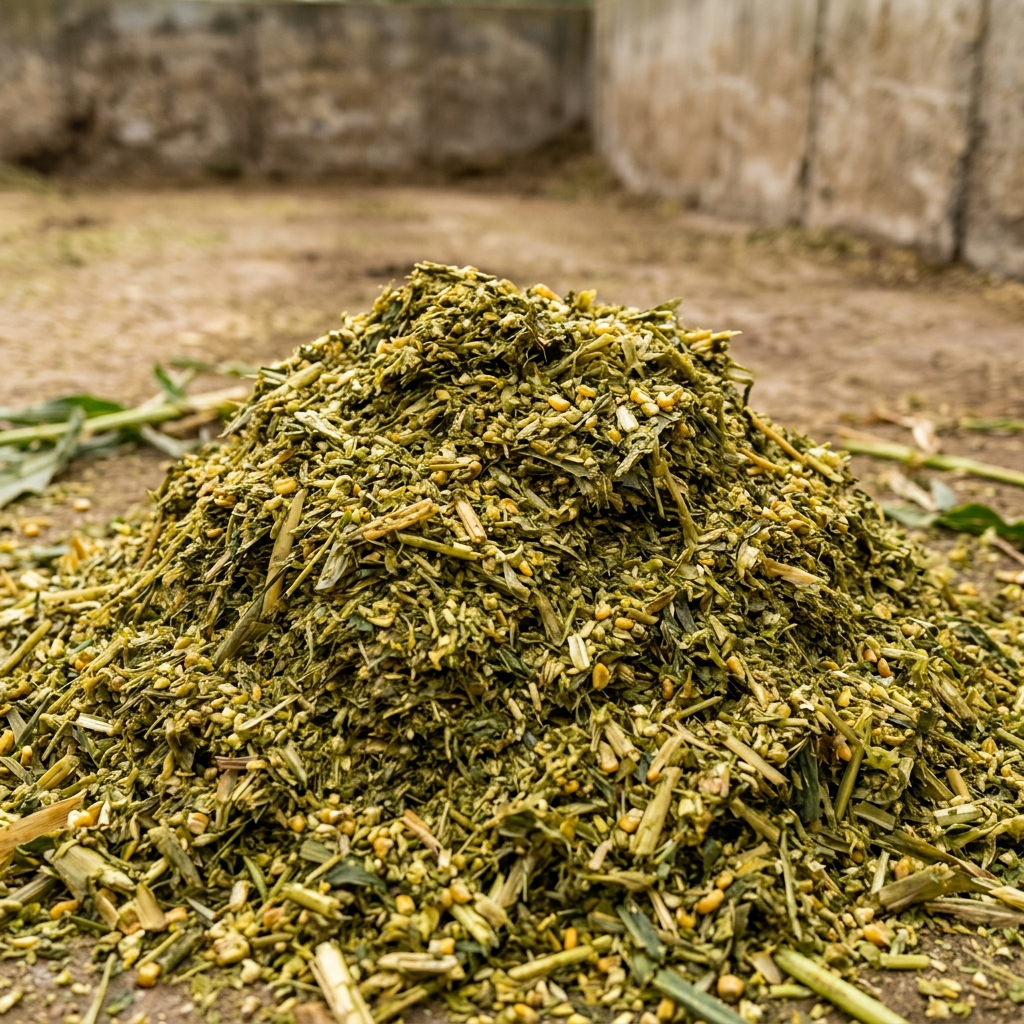
Premium fermented corn silage exported from Gujarat, India — providing the highest-energy forage base for dairy herds in the USA, UK, Australia, New Zealand, and Europe. Consistent milk flow, strong rumen health, and better fertility — season after season.
- IEC Registered Exporter
- Third-Party Quality Certified
- Ships to USA · UK · Australia · EU
RaahaExim’s corn silage is harvested at peak starch content to deliver 20–25% more metabolizable energy than traditional dry hay. This high energy density is essential for maintaining milk potential in high-producing dairy cows during peak lactation. Vacuum-sealed and exported from Gujarat, our silage includes full fermentation analysis and phytosanitary certification for the USA, UK, Australia, and Europe.
Corn Silage vs Dry Hay vs Crop Residue — Forage Quality Comparison
| Performance Parameter | Dry Hay / Crop Residue | RaahaExim Corn Silage |
|---|---|---|
| Metabolizable Energy (MJ/kg DM) | 7–9 MJ — low | 10–11 MJ — 20–25% higher |
| Dry Matter Intake Stimulation | Moderate — can limit intake | High — stimulates voluntary DMI |
| Starch Content | Very low — mainly fibre | 28–35% starch — direct milk energy |
| Rumen pH Buffering | Poor — acidosis risk at high grain | Good — lactic acid stabilises rumen pH |
| Year-Round Availability | Seasonal — quality variable | 12+ months in sealed bales |
| Milk Yield Response | Limited — insufficient energy for peak cows | +1.9 kg more milk/cow/day (average)* |
| Fertility and Reproductive Support | Poor energy balance — delays return to cycle | Good — supports energy balance post-calving |
| Metabolic Disease Risk | Higher — energy gaps drive ketosis | Lower — consistent energy supply |
| Storage Stability | Quality degrades over time | Full nutrition stable for 12+ months sealed |
* Milk yield response based on published research data: inclusion of corn silage in grass silage-based dairy rations improved forage dry matter intake by 2 kg/day and milk yield by 1.9 kg/day on average (Journal of Dairy Science).
Technical specifications
Product specifications
Nutritional Profile of Corn Silage
| Nutrient | Typical Value | Basis |
|---|---|---|
| Dry Matter (DM) | 30–35% | As-fed basis |
| Metabolizable Energy | 10–11 MJ/kg DM | DM basis |
| Crude Protein | 7–9% | DM basis |
| Starch Content | 28–35% | DM basis |
| Neutral Detergent Fibre (NDF) | 40–48% | DM basis |
| Acid Detergent Fibre (ADF) | 22–28% | DM basis |
| Crude Fat (Ether Extract) | 3–4% | DM basis |
| Total Ash | 3–5% | DM basis |
Packaging & Logistics
| Parameter | Details |
|---|---|
| Packaging Type | Vacuum-sealed round bales (multi-layer stretch film) |
| Bale Weight | 100–400 kg per bale (approximate) |
| Shelf Life | 12+ months (ambient covered storage, sealed) |
| Storage Requirement | Covered, dry area — no refrigeration required |
| MOQ | 1 × 20ft container (~15–18 MT) |
| Loading | FCL (Full Container Load) or LCL available |
| Incoterms Available | FOB Mundra / CIF destination port |
| Origin | Gujarat, India |
| HS Code | 1214.90 (Other forage products and fodder) |
Fermentation Quality Parameters
| Parameter | Target Range (Premium Grade) |
|---|---|
| pH after fermentation | 3.8–4.2 |
| Lactic Acid | 5–8% of DM |
| Acetic Acid | < 3% of DM |
| Butyric Acid | < 0.1% of DM |
| Ammonia Nitrogen (% of total N) | < 10% |
| Yeast Count | < 1×10⁵ cfu/g |
| Mould Count | < 1×10⁴ cfu/g |
| Aflatoxin B1 | < 5 ppb (dairy grade) |
All fermentation parameters are verified by third-party accredited laboratory analysis. Certificate of Analysis provided with every shipment.
Corn Silage — Export Compliance by Destination Market
| Destination | Regulatory Body | Key Documentation Required |
|---|---|---|
| USA | USDA APHIS | Phytosanitary certificate, aflatoxin test report (<20 ppb dairy), COO, heat treatment cert if required |
| United Kingdom | APHA | Phytosanitary cert, IPAFFS pre-notification, fermentation quality report, English labelling |
| Australia | DAFF / Biosecurity | Phytosanitary cert, import permit, heat treatment cert, fermentation analysis, mycotoxin screening |
| New Zealand | MPI Biosecurity | Phytosanitary cert, MPI import health standard documents, fermentation report |
| European Union | EC Forage Regulations | Phytosanitary cert, quality analysis, COO, EU-compliant labelling, aflatoxin B1 test |
Import regulations for corn silage — particularly for Australia and New Zealand — are updated periodically. Contact us with your destination country and we will confirm current requirements before your order.
Technical Compliance Sheet — Maize Corn Silage
| Sr. No. | Description | Value | Compliance (Yes / No / Details) |
|---|---|---|---|
| 1 | pH | 3.8–4.4 | |
| 2 | Colour | Golden Brown / Greenish Yellow | |
| 3 | Dry Matter | 30–35% | |
| 4 | Crude Protein | 7–8% | |
| 5 | Crude Fibre | 24–32% | |
| 6 | Crude Fat (Approx.) | 1.5% | |
| 7 | Total Ash (Less than) | 2.2% | |
| 8 | Pack Size | 70–100 KG bale | |
| 9 | Moisture | 65–70% | |
| 10 | Bale Pack | No damaged bale will be acceptable |
Tender ID: 286716. To be filled, printed on letter head of bidder and uploaded on n-procure website.
Request a quote for cattle feed pellets export
Tell us your destination country, required quantity, and packaging preference — we respond within 24 hours with a detailed FOB or CIF quotation, current shipping schedule, and sample documentation.
Send Your Enquiry
Fill in the form below and our export team will contact you within 24 hours with pricing and specifications.
Frequently Asked Questions
Common Questions from International Buyers
The minimum order is one 20-foot container, which holds approximately 15–18 metric tonnes of sealed silage bales depending on bale dimensions and container packing. We also accommodate trial LCL (less-than-container load) shipments for buyers evaluating their first import. Contact us to discuss the best option for your volume.
We provide a third-party fermentation quality analysis with every shipment — covering pH, lactic acid content, acetic acid, butyric acid, ammonia nitrogen, and dry matter. This report is prepared by an accredited laboratory and supplied with the shipping documents so you can verify quality before the container is loaded
We harvest at the two-thirds milk-line dough stage, when the corn grain has 30–35% dry matter. Research consistently shows this is the optimal point for maximum starch content and digestibility — giving the highest energy silage possible. Harvesting earlier reduces starch; harvesting later reduces digestibility. Harvest timing is the single most important quality factor in corn silage.
We offer FOB (Free on Board) from Mundra Port, Gujarat and CIF (Cost, Insurance, Freight) to your destination port. For first-time importers, CIF is the simpler choice — we manage freight and insurance to your port. Experienced importers often prefer FOB for greater logistics control and cost management.
Our corn silage is packed in vacuum-sealed round bales, each approximately 300–400 kg, wrapped in multiple layers of stretch film to ensure airtight storage. This packaging maintains fermentation quality and prevents spoilage for 12+ months from the production date in ambient covered storage — no refrigeration required.
Yes. We can arrange sample bales for qualified buyers who are evaluating the product for the first time. Sample shipments include a full fermentation analysis and nutritional profile. Contact us with your destination country and we will advise on the sample arrangement process.